
Mental Exhaustion: Causes, Signs and How to Recover
Feeling mentally exhausted and completely drained? Discover the real neurological causes of mental exhaustion and the most effective science-backed ways to recover.

disclosure This article contains affiliate links. Purchases may earn us a commission at no extra cost to you. We only recommend products we've reviewed.
featured in this review
Audio Brain Programs
A 7-minute daily audio that uses neuroscience-backed sound frequencies to sharpen focus, boost memory, and unlock your brain's full potential. Used by 80,000+ people worldwide.
Mental Exhaustion: Why Your Brain Feels Completely Drained and How to Recover
You did not run a marathon today.
You sat at a desk, attended meetings, read emails, made decisions, and thought about problems. And yet by the end of the day — or sometimes by mid-morning — your brain feels as if it has been wrung dry.
Mental exhaustion is one of the most common and least understood experiences of modern professional life. It is not laziness. It is not weakness. It is a genuine neurological state — with specific causes, measurable effects, and effective solutions.
Understanding what is actually happening in your brain when it feels completely drained is the first step toward genuinely recovering — and preventing it from becoming your permanent baseline.
What Is Mental Exhaustion — The Neuroscience
Mental exhaustion is not simply "being tired." It is a distinct neurological state characterised by the depletion of specific cognitive resources — resources that thinking, deciding, and focusing consume, and that rest and recovery replenish.
Decision Fatigue
Every decision your brain makes — from what to eat for breakfast to a complex strategic judgment — consumes glucose and depletes the prefrontal cortex's capacity for subsequent decisions. This is called decision fatigue — and it is measurable, predictable, and cumulative.
Research demonstrates that the quality of decisions measurably deteriorates throughout the day as decision-making resources are consumed. A widely cited study of Israeli parole board judges, for example, found they were significantly more likely to grant parole at the beginning of the day and after breaks — and significantly less likely as decision fatigue accumulated (see References below).
Attention Depletion
Sustained attention — the ability to keep the Task-Positive Network engaged on a specific task — consumes energy at a measurable rate. The longer and more demanding the attention demands, the faster these resources deplete.
What most people experience as "can't concentrate anymore" is the neurological reality of genuinely depleted attentional resources — not a failure of discipline.
Cognitive Load Accumulation
Beyond decisions and attention, the sheer volume of information processed, filtered, and managed throughout a modern working day creates cognitive load that accumulates. Email, Slack, meetings, reports, requests — each requiring processing, prioritisation, and response — add to a mounting cognitive burden that eventually exceeds the brain's comfortable processing capacity.
Neurotransmitter Depletion
Sustained cognitive work — particularly work involving stress, high stakes, or complex problem-solving — depletes specific neurotransmitters including dopamine, serotonin, and acetylcholine. When these neurotransmitters are depleted, the experience is often one of mental flatness, emotional blunting, and the inability to feel engaged or motivated — even about things that normally matter.
The Warning Signs of Mental Exhaustion
Mental exhaustion often develops gradually — making it easy to normalise until it becomes severe. Common warning signs include:
Cognitive Warning Signs
- Difficulty starting tasks — even simple ones feel overwhelming
- Reduced working memory — forgetting what you were doing mid-task
- Slower processing speed — taking longer to understand and respond to information
- Decision paralysis — inability to make even straightforward choices
- Increased errors — making mistakes you would normally catch
- Loss of creativity — inability to generate novel ideas or solutions
Emotional Warning Signs
- Emotional blunting — reduced ability to feel positive emotions
- Increased irritability — disproportionate frustration with minor obstacles
- Reduced empathy — difficulty caring about others' needs or perspectives
- Cynicism — negative framing of situations that would normally feel neutral
Physical Warning Signs
- Persistent headaches — particularly frontal headaches that worsen through the day
- Eye strain — even with normal screen time
- Physical heaviness — limbs feeling heavier than normal
- Disrupted sleep — difficulty falling asleep despite exhaustion, or sleeping but not feeling restored
If you recognise five or more of these signs regularly — mental exhaustion is likely affecting your quality of life and professional performance significantly.
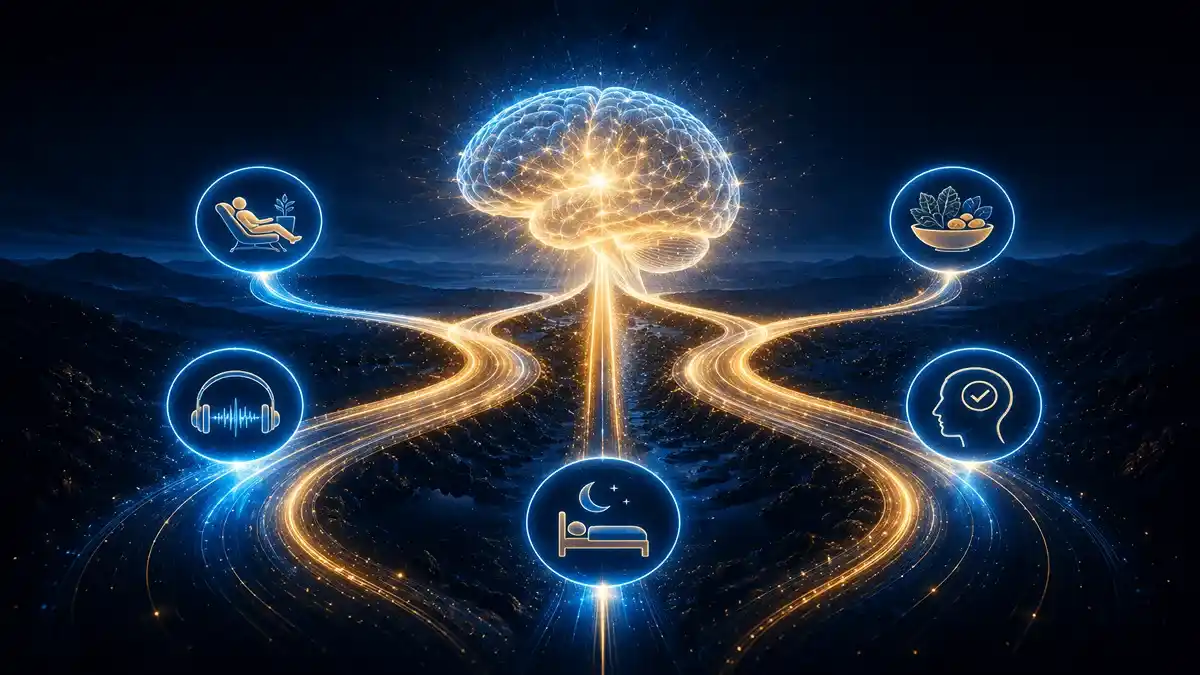
The Most Common Causes of Chronic Mental Exhaustion
1. Chronic Sleep Debt
Sleep is when the brain clears metabolic waste products — including adenosine, the neurotransmitter that accumulates during waking hours and produces the feeling of mental fatigue. During sleep, the glymphatic system — the brain's waste clearance mechanism — becomes highly active, flushing out the byproducts of cognitive work.
When sleep is chronically insufficient, this clearance is incomplete. Adenosine and other waste products accumulate progressively — producing the persistent mental heaviness that characterises chronic mental exhaustion.
2. Unprocessed Stress
Unresolved stress does not disappear when the stressor is temporarily absent. It remains in the nervous system as sustained activation — consuming energy, maintaining heightened cortisol levels, and preventing the genuine rest that mental recovery requires.
This is why a weekend of apparent rest often fails to restore mental energy when the underlying sources of chronic stress remain unaddressed.
3. Digital Cognitive Overload
The average professional receives hundreds of digital communications daily — emails, messages, notifications, and requests — each requiring cognitive processing. This volume of information processing creates cognitive load that significantly exceeds what the human brain evolved to manage.
The result is not just tiredness — it is a specific kind of depletion characterised by the inability to engage meaningfully with anything, combined with the compulsive continuation of the same digital consumption that caused the depletion.
4. Absence of Genuine Recovery
Most people do not genuinely rest during their rest periods. They switch from work screens to social media screens — replacing one form of cognitive engagement with another. The brain never enters the genuine rest state required for cognitive resource restoration.
True mental recovery requires periods of genuine low-stimulation rest — walking in nature, quiet contemplation, genuine conversation, or sleep. Not digital consumption of a different kind.
5. Meaning Deficit
Research on burnout — the extreme end of the mental exhaustion spectrum — consistently identifies meaning deficit as a primary driver. When cognitive effort is sustained without a sense of purpose, connection to outcomes, or personal significance, the depletion accelerates dramatically.
This is why equally demanding cognitive work can feel energising in one context and exhausting in another — the meaning attached to the effort powerfully modulates the rate of cognitive resource depletion.
The Most Effective Recovery Methods
Recovery Method 1 — Genuine Rest, Not Digital Switching
The most immediately impactful recovery intervention is also the simplest: genuine rest.
This means periods of low-stimulation activity that allow the brain's default mode network to operate freely — without the demands of task engagement or the stimulation of digital content.
Effective genuine rest activities:
- Walking in natural environments — even a short walk of 20 minutes or so has been associated with reduced cortisol and restored cognitive capacity
- Quiet contemplation or meditation
- Slow, enjoyable conversation without agenda
- Light physical activity that does not require complex cognitive engagement
- Brief naps of 10-20 minutes — long enough for adenosine clearance without entering deep sleep
Recovery Method 2 — Audio Brain Training for State Reset
One of the most effective tools for interrupting the cycle of mental exhaustion is direct intervention at the brain wave level.
Mental exhaustion is characterised neurologically by depleted prefrontal cortex activity and disrupted theta wave regulation — the brain is stuck in a depleted, low-energy state that spontaneous rest sometimes fails to resolve.
The Brain Song uses Theta wave binaural beat technology to directly activate the brain wave patterns associated with calm, restored mental clarity — interrupting the exhaustion cycle and supporting genuine cognitive recovery.
Many users report that a 7-minute session of The Brain Song during a midday break produces mental clarity comparable to a short nap — without the grogginess that napping can produce.
This is not about stimulation — it is about restoration. The Theta frequencies The Brain Song delivers are the same frequencies the brain naturally produces during deep rest and recovery states.

Recovery Method 3 — Sleep Restoration as Priority
If mental exhaustion is chronic — present most days regardless of apparent rest — sleep is almost certainly a contributing factor.
The glymphatic clearance of cognitive waste products happens primarily during deep sleep. Without adequate deep sleep, the metabolic byproducts of cognitive work accumulate progressively — producing the "always tired" baseline that many chronically mentally exhausted people experience.
Priority sleep interventions for mental exhaustion recovery:
- Increase sleep duration to 7-9 hours consistently — not just on weekends
- Improve sleep quality: cool, dark, quiet bedroom
- Address sleep disruption causes: stress, alcohol, screens before bed
- The Memory Wave before sleep — supports the Theta wave transitions that facilitate deep sleep onset
Recovery Method 4 — Reduce Cognitive Load at the Source
Addressing the volume of cognitive processing demands is often more effective than trying to recover from their effects.
Practical cognitive load reduction:
- Email batching — check email twice daily at fixed times rather than continuously
- Single-tasking — one task to completion before beginning another
- Decision simplification — reduce the number of decisions requiring active deliberation through routines, defaults, and pre-commitments
- Meeting reduction — ruthlessly evaluate which meetings require your presence
- Digital notification elimination — default to off for all non-essential notifications
Recovery Method 5 — Nutritional Support for Neurotransmitter Restoration
Mental exhaustion often involves neurotransmitter depletion that nutritional support can address:
Dopamine support — tyrosine-rich foods (chicken, eggs, dairy, legumes) or L-Tyrosine supplementation supports dopamine synthesis. Particularly relevant for the motivational flatness that characterises advanced mental exhaustion.
Acetylcholine support — choline-rich foods (eggs, liver, fish) support the acetylcholine synthesis that focus and memory depend on. Citicoline supplementation provides direct choline precursor support.
Serotonin support — tryptophan-rich foods (turkey, oats, seeds) support serotonin synthesis, relevant for the mood components of mental exhaustion. Regular aerobic exercise is the most effective natural serotonin booster.
Cortisol reduction — Ashwagandha KSM-66 is one of the most well-researched natural adaptogens for cortisol reduction, with clinical trials showing meaningful reductions in serum cortisol and perceived stress — directly addressing the stress component of mental exhaustion (see References below).

The Mental Exhaustion Recovery Protocol
This protocol is designed for professionals experiencing moderate to significant mental exhaustion — present most days, affecting work quality and personal wellbeing.
Immediate — this week:
- Identify and eliminate your three highest cognitive load sources — the meetings, notifications, or tasks producing the most depletion for the least value
- Implement genuine rest during at least one break daily — walk outside, not phone scrolling
- Begin The Brain Song daily — 7 minutes each morning and optionally at midday
Short-term — weeks 2-4:
- Extend sleep to 7-9 hours consistently
- Add L-Tyrosine 500mg in the morning to support dopamine restoration
- Add Ashwagandha KSM-66 300mg daily for cortisol management
- Aerobic exercise minimum 3 times per week — 20-30 minutes
Ongoing:
- Protect genuine rest periods — treat them as non-negotiable
- Continue The Brain Song as a daily cognitive maintenance ritual
- Monitor and limit total daily decision volume
- Address any persistent, unresolved sources of chronic stress directly
When to Seek Professional Support
Mental exhaustion that does not improve with the interventions above — or that is accompanied by persistent depression, anxiety, or significant functional impairment — warrants professional assessment.
Burnout — the clinical extreme of mental exhaustion — is a recognised occupational health condition that benefits from professional support alongside lifestyle interventions. If mental exhaustion is severe, seek support rather than attempting to push through alone.
Frequently Asked Questions
How long does it take to recover from mental exhaustion?
Mild mental exhaustion typically responds to 1-2 weeks of consistent rest, sleep improvement, and cognitive load reduction. Moderate exhaustion may require 4-6 weeks. Severe burnout can take months of sustained recovery — professional support is recommended in these cases.
Is The Brain Song safe to use when mentally exhausted?
Yes — completely. The Brain Song uses natural sound frequencies that support rest and recovery states. It is particularly suitable for mental exhaustion because it activates Theta wave states associated with calm restoration rather than stimulating alertness.
Can I use these tools alongside medication for burnout or depression?
The Brain Song and nutritional supplements mentioned in this guide are generally safe alongside medication. However, always consult your healthcare provider before combining supplements with prescription medications.
Will exercise make mental exhaustion worse?
Light to moderate aerobic exercise — walking, gentle cycling, swimming — consistently improves mental exhaustion even when it feels counterintuitive. Intense exercise during severe exhaustion can temporarily worsen symptoms. Start gently and build gradually.
Is there a money-back guarantee on The Brain Song?
Yes — 365 days. Completely risk-free to try during your recovery period.
Related Guides
Looking for more support with brain health and cognitive recovery?
→ Brain Fog: Causes, Symptoms and Natural Solutions
→ Why Is My Memory Getting Worse? Causes and Solutions
→ How to Improve Concentration — 8 Science-Backed Methods
→ Best Nootropics for Anxiety and Mental Stress
→ The Brain Song Review — Complete Independent Review
This content is based on information from:
- Peer-reviewed research on burnout and cognitive function
- Peer-reviewed research on decision fatigue and cortisol/stress physiology
Last updated: 8 September 2026
References
1. Maslach C, Leiter MP. (2016). Understanding the burnout experience: recent research and its implications for psychiatry. World Psychiatry. 15(2):103-111.
2. Gavelin HM, Domellöf ME, Åström E, et al. (2022). Cognitive function in clinical burnout: a systematic review and meta-analysis. Work Stress. 36(1):86-104.
3. Danziger S, Levav J, Avnaim-Pesso L. (2011). Extraneous factors in judicial decisions. Proc Natl Acad Sci USA. 108(17):6889-6892.
4. Besedovsky L, Lange T, Haack M. (2019). The Sleep-Immune Crosstalk in Health and Disease. Physiol Rev. 99(3):1325-1380.
5. Chandrasekhar K, et al. (2012). A prospective, randomized double-blind, placebo-controlled study of safety and efficacy of ashwagandha root. Indian J Psychol Med. 34(3):255-62.
6. Lopresti AL, Smith SJ, Malvi H, Kodgule R. (2019). An investigation into the stress-relieving and pharmacological actions of an ashwagandha (Withania somnifera) extract. Medicine (Baltimore). 98(37):e17186.