
Tinnitus at Night: Why It Gets Worse and How to Sleep
Why does tinnitus get worse at night? Discover the real neurological reasons and the most effective science-backed solutions to sleep better despite ear ringing.
disclosure This article contains affiliate links. Purchases may earn us a commission at no extra cost to you. We only recommend products we've reviewed.
featured in this review
NeuroTinn
Natural sound therapy program designed to help reduce tinnitus perception, promote relaxation, and improve sleep without medication.
Tinnitus at Night: Why Ringing Gets Worse Before Bed and How to Sleep Better
The house is finally quiet.
The day is over. The conversations, the traffic,
the notifications — all of it has stopped.
And yet, just as you settle into bed and close
your eyes, the ringing begins.
Or rather — it was always there. But now, in
the silence, it is all you can hear.
For millions of adults living with tinnitus,
nighttime is the hardest part. The ringing
that was manageable during the day becomes
impossible to ignore the moment the world
goes quiet.
If this is your experience — there is a
neurological reason for it. And there are
evidence-based solutions that can help.
Quick Answer
Why does tinnitus get worse at night?
Tinnitus feels louder at night primarily
because daytime background noise naturally
competes with the ringing — masking it from
conscious awareness. When the environment
becomes quiet, the brain has fewer external
sounds to process and becomes hypersensitive
to internal neural signals — including the
self-generated sound of tinnitus. This is
called reduced masking, and it is the primary
reason tinnitus seems to intensify at bedtime.
Sound therapy programs like NeuroTinn are
specifically designed to address this by
providing structured audio that reduces the
brain's focus on internal sounds before sleep.
Why Tinnitus Feels Louder at Night — The Neuroscience
Understanding why tinnitus intensifies at night
requires understanding how the brain processes
sound — and what happens when external sound
stimulation drops.
The Masking Effect
Throughout the day, your auditory cortex is
constantly processing a rich stream of external
sounds — conversations, traffic, music, air
conditioning, office noise, birds, footsteps.
This continuous external stimulation naturally
competes with tinnitus for the brain's attention.
The ringing exists — but it is one signal among
hundreds that the brain is simultaneously processing.
At night, this external stimulation disappears.
With nothing competing for the auditory cortex's
attention, the brain's self-generated tinnitus
signal becomes the dominant — and often only —
sound being processed.
This is called the masking effect, and its
disappearance at night is the primary reason
tinnitus seems to intensify at bedtime.
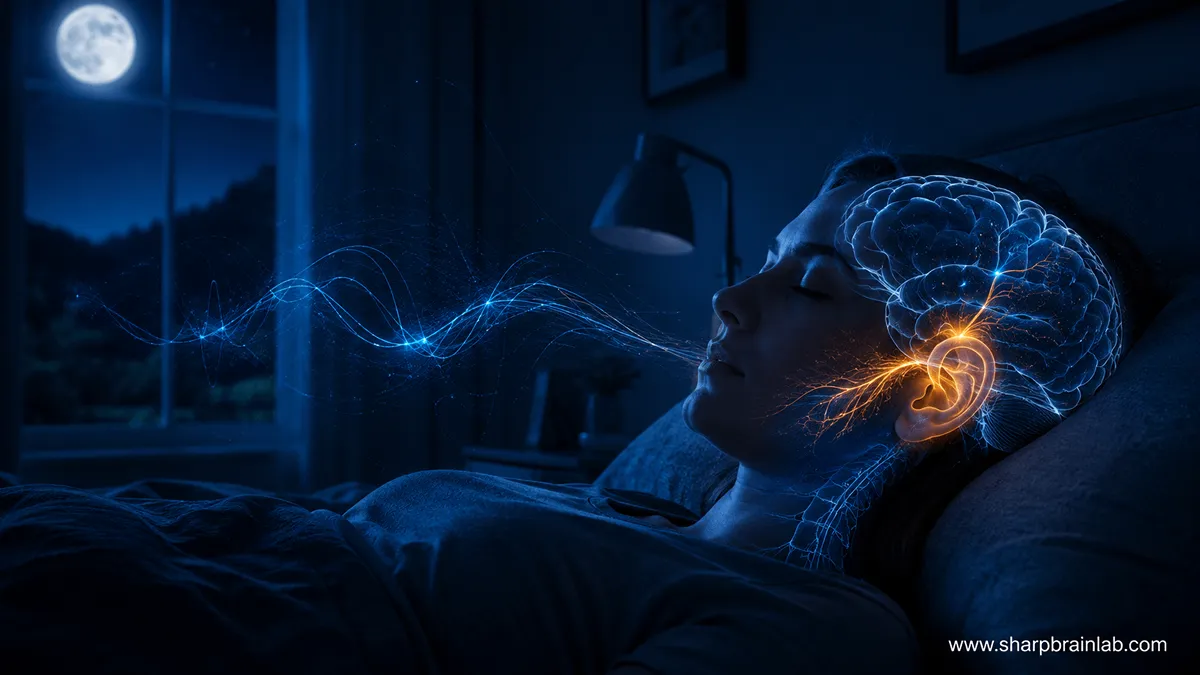
Central Sensitisation — The Brain's Role
Modern tinnitus research has established that
tinnitus is not simply an ear problem. It is
a neurological phenomenon — the result of
the auditory cortex generating its own neural
activity in response to reduced or damaged
auditory input.
In quiet environments — and particularly at
night — this central sensitisation becomes
more pronounced. The brain, receiving less
external auditory stimulation, amplifies its
own internal signals. The result is the
experience of louder, more intrusive ringing
precisely when you most want silence.
Stress and Cortisol at Bedtime
For many people, bedtime is when the day's
unprocessed stress finally surfaces.
The psychological release of lying down —
without the distractions of work, activity,
and social engagement — allows accumulated
stress and anxiety to become conscious.
Elevated cortisol and anxiety directly increase
neural hyperactivity in the auditory cortex —
amplifying the tinnitus signal and making it
more difficult to habituate to the sound
enough to sleep.
This creates the cycle that many tinnitus
sufferers know well: the ringing keeps you
awake, the sleeplessness increases stress,
the stress worsens the tinnitus, and so on.
Attention and Hypervigilance
There is also a purely attentional component
to nighttime tinnitus.
During the day, cognitive engagement — work,
conversation, activity — directs attention
away from internal sensations. At bedtime,
with no external focus for attention, the
mind naturally turns inward.
For tinnitus sufferers who have developed
hypervigilance to their symptoms — a common
psychological consequence of chronic tinnitus —
this inward attention is directed almost
immediately to the ringing. And focused
attention on tinnitus reliably increases
its perceived intensity.
How Tinnitus Disrupts Sleep Architecture
The impact of tinnitus on sleep goes beyond
simply making it harder to fall asleep.
It affects the quality of sleep at an
architectural level.
Sleep Onset Difficulty
The transition from wakefulness to sleep
requires a progressive reduction in arousal —
physical, cognitive, and emotional. Tinnitus —
particularly when accompanied by anxiety about
the ringing — maintains a state of arousal
that directly prevents this transition.
Many tinnitus sufferers report lying awake
for 30-60 minutes or more before sleep onset —
time spent in a state of hyperarousal focused
on the ringing.
Sleep Fragmentation
Even after sleep onset, tinnitus can cause
multiple partial awakenings throughout the
night — brief moments of wakefulness that
the sleeper may not fully remember but that
prevent the sustained deep sleep and REM
sleep that genuine restoration requires.
Reduced Deep Sleep
Chronic sleep disruption from tinnitus
systematically reduces the proportion of
slow-wave deep sleep — the most physically
restorative stage. The resulting sleep debt
increases daytime fatigue, reduces cognitive
performance, and often worsens tinnitus
perception the following day.
The Most Effective Solutions for Nighttime Tinnitus
Solution 1 — Sound Therapy Before Bed
Sound therapy is the most widely used
and evidence-supported non-pharmaceutical
approach for nighttime tinnitus.
Rather than eliminating the ringing — which
is not currently possible for most forms of
chronic tinnitus — sound therapy introduces
carefully designed audio that reduces the
contrast between silence and the tinnitus signal.
NeuroTinn is a digital sound therapy program
specifically designed for people seeking a
drug-free approach to tinnitus management.
It uses precision binaural beats technology
to help reduce the brain's focus on internal
sounds — making the transition to sleep
calmer and less dominated by tinnitus awareness.
Unlike simple white noise — which masks the
ringing with random noise — NeuroTinn uses
structured binaural beat frequencies that
engage the auditory cortex more directly,
supporting the neural habituation that
reduces tinnitus perception over time.
Used consistently before bed as part of a
nighttime routine, many users report that
NeuroTinn makes bedtime significantly calmer
and tinnitus less intrusive during the
critical sleep-onset window.
If you are ready to try a structured, drug-free
approach to nighttime tinnitus relief — click
below for risk-free access with a 60-day
satisfaction guarantee.
Solution 2 — Address Sleep Quality Directly
For tinnitus sufferers whose primary complaint
is sleep disruption rather than daytime
ringing intensity — addressing sleep quality
directly alongside tinnitus management
produces the best outcomes.
YuSleep is a natural sleep formula that
addresses the cortisol and nervous system
overactivation that both tinnitus and poor
sleep share as contributing mechanisms.
Many tinnitus sufferers experience elevated
nighttime cortisol — both as a cause of
tinnitus exacerbation and as a result of
the anxiety and hypervigilance that chronic
tinnitus produces. YuSleep's Lemon Balm
and GABA components specifically address
this cortisol pathway — supporting the
nervous system calming that both better
sleep and reduced tinnitus awareness require.
The combination of NeuroTinn for the
auditory component and YuSleep for the
sleep quality component addresses both
dimensions of the nighttime tinnitus problem.
Solution 3 — Pre-Sleep Cortisol Management
Managing the stress and cortisol that
amplify nighttime tinnitus:
Pre-sleep writing — spend 5 minutes
writing tomorrow's priorities and any
unresolved concerns before bed. This
offloads active cognitive processing and
reduces the rumination that elevates cortisol
at bedtime.
Slow breathing — 4 seconds inhale,
6 seconds exhale for 5 minutes before
sleep. This directly activates the
parasympathetic nervous system and reduces
cortisol — measurably calming the neural
hyperactivity that amplifies tinnitus.
Consistent sleep schedule — irregular
sleep timing elevates cortisol and
disrupts the circadian rhythm that regulates
both sleep quality and auditory cortex
sensitivity.
Solution 4 — Optimise the Sleep Environment
Temperature — 16-19°C is optimal for
sleep onset and deep sleep maintenance.
Darkness — complete darkness reduces
cortisol and supports melatonin production.
Gentle background audio — for tinnitus
sufferers who find complete silence
intolerable, very low-level background
audio — natural sounds, soft music, or
the structured audio of NeuroTinn —
can bridge the gap between silence and
sleep onset.
Solution 5 — Reduce Pre-Sleep Stimulation
No screens 60 minutes before bed —
blue light suppresses melatonin and
maintains the cortisol levels that amplify
tinnitus perception.
No caffeine after 1-2 PM — caffeine's
6-hour half-life maintains neural stimulation
and elevates cortisol well into the evening.
No intense exercise within 3 hours of bed
— while exercise is excellent for tinnitus
management overall, evening exercise elevates
cortisol and core body temperature in ways
that worsen sleep onset and tinnitus perception.
Key Takeaways
✓ Tinnitus feels louder at night primarily
because daytime background noise that
naturally masks the ringing disappears —
leaving the brain's self-generated
tinnitus signal as the dominant auditory
experience
✓ Central sensitisation — the auditory
cortex's amplification of internal signals
— is more pronounced in quiet environments,
making nighttime the most challenging
period for most tinnitus sufferers
✓ Sound therapy before bed — particularly
structured binaural beats programs like
NeuroTinn — addresses the neural mechanism
of nighttime tinnitus more effectively
than simple masking
✓ Elevated nighttime cortisol from stress
directly worsens tinnitus perception —
addressing both the auditory and cortisol
components produces better outcomes than
either approach alone
✓ NeuroTinn and YuSleep address both
dimensions of nighttime tinnitus —
the auditory neural component and the
sleep quality and cortisol component
If your primary challenge is nighttime tinnitus
disrupting sleep — you may find that combining
structured sound therapy with natural sleep
support addresses both dimensions of the problem
more comprehensively than either alone.
Frequently Asked Questions
Why does tinnitus get worse at night?
Because daytime background noise naturally
competes with tinnitus for the brain's
attention — masking the ringing. When this
masking disappears at night, the tinnitus
signal becomes the dominant auditory
experience. This is called the masking effect,
and it is the primary reason tinnitus seems
louder at bedtime.
Does tinnitus actually get louder at night?
Not necessarily. The actual tinnitus signal
may not change — what changes is how much
of the brain's attention it receives when
external masking sounds disappear. For many
people, the tinnitus intensity is the same
as during the day — but it becomes far more
noticeable in the absence of competing sounds.
Can stress make nighttime tinnitus worse?
Yes — significantly. Elevated cortisol from
stress increases neural hyperactivity in the
auditory cortex, directly amplifying tinnitus
perception. Many people notice that tinnitus
is most intrusive on high-stress evenings.
Managing cortisol before bed — through
slow breathing, pre-sleep writing, and
natural cortisol-reducing supplements —
can meaningfully reduce nighttime tinnitus intensity.
Does sound therapy actually help tinnitus at night?
Sound therapy is one of the most widely
recommended non-pharmaceutical approaches
for nighttime tinnitus. It works by reducing
the contrast between silence and the tinnitus
signal — making the ringing less dominant
in the brain's auditory processing. Structured
programs like NeuroTinn go further by using
binaural beats to engage the auditory cortex
directly and support neural habituation over time.
Can I use NeuroTinn every night?
Yes — consistent nightly use is recommended
for best results. Neural habituation —
the process through which the brain learns
to treat tinnitus as a neutral, non-threatening
signal — develops gradually with consistent
daily practice.
Is there a money-back guarantee?
Yes — NeuroTinn offers a 60-day satisfaction
guarantee. If it is not right for you for
any reason, contact the company for a full
refund. No questions asked.
Related Guides
→ Why Do I Hear Ringing in My Ears? Causes and What You Can Do
→ NeuroTinn Review: Does It Actually Reduce Tinnitus?
→ How to Sleep Better for Brain Health — Complete Guide
→ YuSleep Review — Natural Sleep Formula
→ Why You Wake Up at 3 AM — Causes and Solutions
Medical Disclaimer
This article is educational and does not replace
professional medical advice. Persistent tinnitus —
particularly when sudden in onset, one-sided, or
accompanied by hearing loss or dizziness — requires
evaluation by a qualified healthcare professional.
Tinnitus can be a symptom of underlying medical
conditions including acoustic neuroma, Meniere's
disease, and cardiovascular disorders. Always
consult your doctor before beginning any new
wellness programme, particularly if you take
prescription medications.
Sharp Brain Lab is an independent editorial platform.
We do not diagnose, treat, or cure any medical condition.
TL;DR
- Why it happens: Silence removes the daytime
background noise that naturally masks tinnitus —
making the brain's self-generated ringing
the dominant auditory experience at night
- What helps: Structured sound therapy before
bed (NeuroTinn) + natural sleep and cortisol
support (YuSleep) — addressing both the
auditory and sleep quality components
- When to see a doctor: Sudden onset, one-sided
tinnitus, or tinnitus with hearing loss or
dizziness requires medical evaluation
- Next step: Try NeuroTinn risk-free for 60 days
as part of a consistent nighttime routine
This content is based on information from:
- PubMed peer-reviewed tinnitus and audiology research
- NIH National Institute on Deafness and Other
Communication Disorders (NIDCD)
- American Tinnitus Association educational resources
- American Academy of Sleep Medicine guidelines
- Journal of the Association for Research
in Otolaryngology published research
Last updated: 20 August 2026
References
1. Lockwood AH, et al. (2002). Tinnitus.
New Engl J Med. 347(12):904-910.
2. De Ridder D, et al. (2014). Tinnitus:
the sound of silence. Cell. 157(6):1264-1266.
3. Bhatt JM, et al. (2017). Prevalence of
and risk factors for tinnitus and hearing
loss in US adults. JAMA Otolaryngol Head
Neck Surg. 142(10):959-965.
4. Langguth B, et al. (2013). Tinnitus:
causes and clinical management.
Lancet Neurol. 12(9):920-930.
5. Folmer RL, Griest SE. (2000). Tinnitus
and insomnia. Am J Otolaryngol. 21(5):287-293.
recomendado
Sleep Optimization
YuSleep
Recommended for adults who struggle with falling asleep, waking up at 3 AM, or waking up tired even after a full night's sleep. YuSleep combines clinically studied ingredients that support deeper, more restorative sleep without creating dependency.
Brain Supplements
Pineal Guardian X
A premium natural brain health supplement designed to support memory, mental clarity, focus, and long-term cognitive performance with a carefully selected blend of plant-based ingredients.
Brain Audio Programs
Audio Brain Programs
A 7-minute daily audio that uses neuroscience-backed sound frequencies to sharpen focus, boost memory, and unlock your brain's full potential. Used by 80,000+ people worldwide.
Brain Audio Programs
The Memory Wave
A targeted audio program that stimulates your brain's memory center using Theta wave technology. Specifically designed for adults over 40 who want sharper recall and clearer thinking.
Brain Audio Programs
The Genius Switch
Neuroscience-backed audio that activates your brain's peak performance mode in minutes. One of the highest-converting brain programs available — thousands of professionals use it daily.