
What Is Tinnitus? Complete Guide to Causes and Relief
What is tinnitus? Discover the complete science-backed guide to causes, symptoms, types, and the most effective natural relief options available in 2026.
disclosure This article contains affiliate links. Purchases may earn us a commission at no extra cost to you. We only recommend products we've reviewed.
featured in this review
NeuroTinn
Natural sound therapy program designed to help reduce tinnitus perception, promote relaxation, and improve sleep without medication.
What Is Tinnitus? The Complete Guide to Causes, Symptoms and Natural Relief
Over 50 million adults in the United States
live with a sound that no one else can hear.
A persistent ringing. A constant buzzing.
A hiss that fills every quiet moment and
refuses to stop.
This condition is called tinnitus — and for
millions of people, it is one of the most
frustrating, exhausting, and misunderstood
experiences in modern medicine.
There is currently no universal cure.
But there is significantly more that can
be done than most people realise — and
understanding exactly what tinnitus is,
how it develops, and how the brain generates
it is the essential foundation for managing
it effectively.
This is the most comprehensive guide to
tinnitus we have published. Whether you
are newly experiencing ear ringing, have
lived with it for years, or are researching
on behalf of someone you care about —
everything you need to understand is here.
Quick Answer
What is tinnitus?
Tinnitus is the perception of sound —
ringing, buzzing, hissing, humming, or
clicking — in the absence of any external
sound source. It affects over 50 million
Americans and approximately 750 million
people worldwide. Tinnitus is not a disease
but a symptom — the result of dysfunction
somewhere in the auditory pathway, from
the outer ear through the cochlea, auditory
nerve, and brain. Modern research has
established that tinnitus is primarily a
brain phenomenon — the auditory cortex
generating its own neural activity in
response to reduced or altered auditory
input. Evidence-based management approaches
include sound therapy, neural retraining
through binaural beats, stress and cortisol
management, and sleep optimisation.
Understanding Tinnitus — What It Actually Is
The Definition
Tinnitus — pronounced either TIN-ih-tus or
tin-EYE-tus — comes from the Latin word
tinnire, meaning "to ring."
Clinically, it is defined as the conscious
awareness of a sound that originates from
within the auditory system rather than from
an external source.
It is not a disease. It is a symptom —
and like all symptoms, it has causes.
Understanding those causes is the first
step toward addressing it.
Why Tinnitus Is Primarily a Brain Problem
This is the most important insight from
modern tinnitus research — and the one that
most conventional treatments fail to act on.
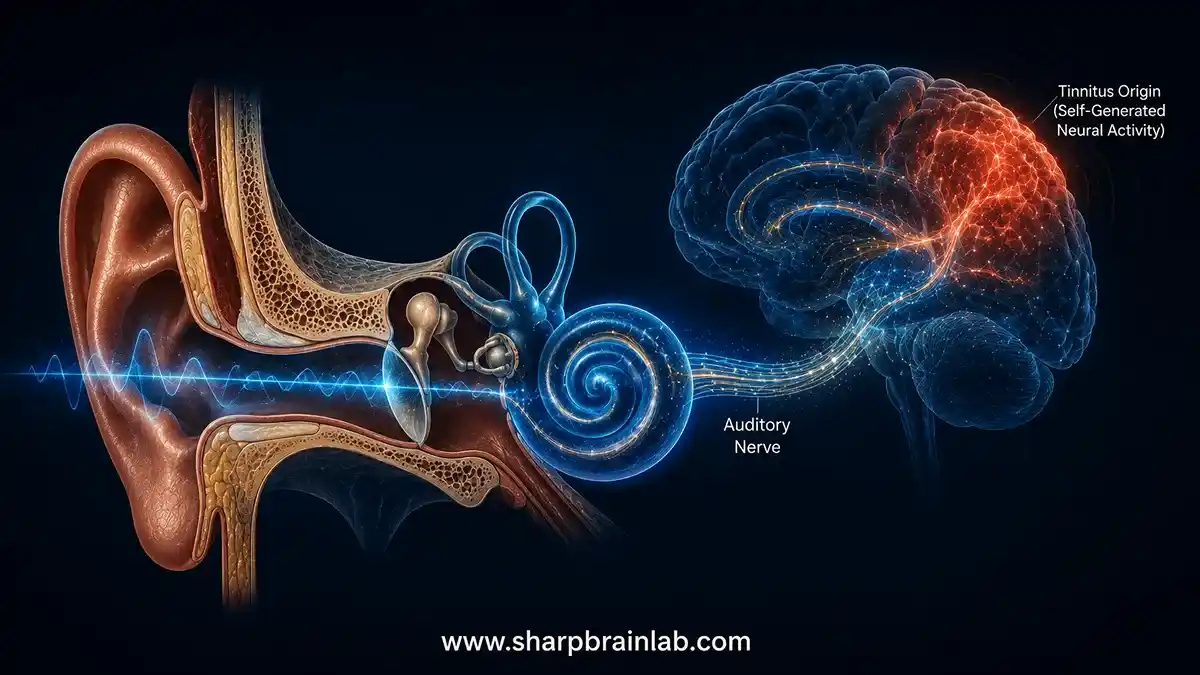
The auditory system works like this:
external sounds vibrate the eardrum,
which transmits vibration through three
small bones to the cochlea — the fluid-filled
spiral structure of the inner ear. Hair
cells within the cochlea convert these
vibrations into electrical signals that
travel via the auditory nerve to the
auditory cortex in the brain, where they
are processed as conscious sound.
When this pathway is disrupted — through
hearing cell damage, noise trauma, medication
effects, or other causes — the auditory
cortex compensates. In the absence of normal
input, it generates its own neural activity.
This self-generated neural activity is
what people experience as tinnitus.
Because tinnitus originates in the brain's
processing of sound — not purely in the ear
itself — it explains why:
- Tinnitus can persist even after the ear
damage has stopped
- Stress and anxiety dramatically worsen it
(both affect cortical hyperactivity)
- Sound therapy that engages the auditory
cortex is more effective than simple masking
- Tinnitus is most noticeable when external
sounds disappear and the brain has no
competing input
How Common Is Tinnitus?
Tinnitus is significantly more common than
most people realise:
- 15% of the global population experiences
some form of tinnitus
- 50+ million Americans are affected
- 20 million experience chronic tinnitus
- 2 million experience severe, debilitating tinnitus
- It is the most common service-connected
disability among US military veterans
- Rates are increasing — linked to noise
exposure, stress, and an ageing population
Types of Tinnitus
Not all tinnitus is the same. Understanding
the type you are experiencing is important
for appropriate management.
Subjective Tinnitus
The most common form — accounting for
approximately 95% of all tinnitus cases.
Subjective tinnitus can only be heard by
the person experiencing it. It is generated
by the auditory cortex in response to
dysfunction in the auditory pathway —
whether from hearing cell damage, noise
exposure, medication effects, or other causes.
The sound may be:
- Constant or intermittent
- High-pitched (ringing, hissing, whistling)
or low-pitched (humming, roaring)
- Present in one ear, both ears, or
perceived inside the head
- Stable or variable in intensity
Pulsatile Tinnitus
A less common but clinically significant form —
accounting for approximately 5% of tinnitus cases.
Pulsatile tinnitus has a rhythmic, pulse-like
quality that often corresponds to the heartbeat.
It is typically caused by turbulent or abnormal
blood flow near the ear — rather than auditory
cortex hyperactivity.
Causes include hypertension, atherosclerosis,
arteriovenous malformations, and middle ear
vascular tumours.
⚠️ Pulsatile tinnitus warrants prompt
medical evaluation — it is more likely
than subjective tinnitus to have a treatable
underlying vascular cause.
Objective Tinnitus
An extremely rare form — less than 1% of cases.
Objective tinnitus produces a sound that can
actually be heard by an examiner using a
stethoscope. It is caused by physical sound
generation within the body — typically from
abnormal muscle contractions or blood vessel
abnormalities near the ear.
It is almost always treatable once the
underlying cause is identified.
What Causes Tinnitus?
Tinnitus develops when something disrupts
the normal functioning of the auditory pathway.
This disruption can occur at multiple points —
and tinnitus often has more than one
contributing cause.
Age-Related Hearing Loss (Presbycusis)
The most common cause worldwide.
As we age, the hair cells of the cochlea
naturally degenerate — particularly those
responsible for processing high-frequency
sounds. This gradual loss of auditory input
triggers compensatory hyperactivity in the
auditory cortex.
Age-related tinnitus typically:
- Develops gradually after age 50-60
- Affects both ears
- Is accompanied by difficulty hearing
high-pitched sounds or understanding
speech in noisy environments
- Is most noticeable in quiet environments
Noise-Induced Hearing Damage
The most common preventable cause.
Exposure to loud sound — whether a single
extreme event (explosion, gunshot, concert)
or repeated moderate exposure (machinery,
headphones, loud music) — damages the
delicate hair cells of the cochlea.
Unlike most cells in the body, cochlear
hair cells do not regenerate once damaged.
The resulting reduction in auditory input
triggers the cortical compensation that
produces tinnitus.
This is why tinnitus is the most common
service-connected disability among US
military veterans — combat noise exposure
produces high rates of permanent cochlear
damage and associated tinnitus.
Earwax Buildup
A simple, immediately reversible cause.
Earwax blocking the ear canal reduces the
transmission of external sound to the
eardrum — reducing auditory input in a
way that can trigger temporary tinnitus.
If tinnitus developed recently without
obvious cause, earwax buildup is worth
ruling out promptly.
Medications — Ototoxic Drugs
Several classes of medication are known
to damage the inner ear and produce tinnitus:
High-dose aspirin and NSAIDs —
salicylate ototoxicity is dose-dependent
and often reversible upon discontinuation.
Aminoglycoside antibiotics — gentamicin,
streptomycin, and related antibiotics can
cause permanent cochlear damage at high doses.
Loop diuretics — furosemide and related
drugs at high doses can cause temporary
or permanent ototoxicity.
Platinum-based chemotherapy agents —
cisplatin and carboplatin carry significant
ototoxic risk.
Quinine-based medications — used for
malaria and leg cramps; associated with
tinnitus at high doses.
If tinnitus began or significantly worsened
after starting a new medication, discuss
this with your prescribing doctor promptly.
Stress and Anxiety
Psychological stress does not cause tinnitus
directly — but it has a profound effect on
its perception and severity.
The mechanism is neurological:
Elevated cortisol and sympathetic nervous
system activation increase the auditory
cortex's neural hyperactivity — directly
amplifying the tinnitus signal. Anxiety
also increases hypervigilance to tinnitus —
directing attention to it in ways that
further increase its perceived intensity.
Many people first become aware of tinnitus
during periods of significant stress — not
because stress created new hearing damage,
but because it lowered the threshold at
which the cortex's background noise became
consciously perceived.
Managing stress is one of the most consistently
effective approaches to reducing tinnitus
impact — precisely because it addresses the
cortical hyperactivity that amplifies the signal.
Cardiovascular Factors
The inner ear is exquisitely sensitive to
blood flow. Any condition that affects
vascular function near the ear can
contribute to tinnitus:
- Hypertension increases pulsatile blood
flow that can be perceived as tinnitus
- Atherosclerosis reduces cochlear circulation
- Anaemia reduces oxygen delivery to
auditory tissues
Maintaining cardiovascular health is a
genuine tinnitus management strategy —
not just general wellness advice.
Other Contributing Factors
Meniere's Disease — an inner ear
condition involving fluid pressure imbalance.
Produces episodic tinnitus, vertigo, and
fluctuating hearing loss. Often affects
one ear initially.
TMJ Disorders — the temporomandibular
joint is anatomically close to the ear.
Jaw muscle tension and joint dysfunction
can produce or worsen tinnitus.
Thyroid Disorders — both hypothyroidism
and hyperthyroidism have been associated
with tinnitus through effects on blood flow
and neural activity.
Head and Neck Injuries — trauma can
affect auditory pathway function directly
or through nerve and muscle disruption.
Acoustic Neuroma — a rare benign tumour
on the auditory nerve, typically producing
one-sided tinnitus with progressive hearing
loss. Requires medical assessment.
Symptoms — What Tinnitus Sounds and Feels Like
Tinnitus manifests differently in different people.
Understanding the range of presentations helps
contextualise your own experience.
Sound Characteristics
The most common descriptions include:
- Ringing — the most commonly reported type
- Buzzing — often described as electrical or mechanical
- Hissing — like steam or white noise
- Humming — a low, constant drone
- Whistling — high-pitched and piercing
- Clicking — rhythmic, sometimes associated with
muscle contractions
- Roaring — ocean-like, often associated with
Meniere's Disease
How It Affects Daily Life
Beyond the sound itself, tinnitus commonly affects:
Sleep — tinnitus is most noticeable in
quiet environments, making bedtime the most
challenging part of the day for many sufferers.
Sleep disruption is the most commonly reported
consequence of chronic tinnitus.
Concentration — the constant background sound
creates cognitive load that reduces available
attention for other tasks. Focus, reading,
and complex work are particularly affected.
Emotional wellbeing — chronic tinnitus
is significantly associated with anxiety,
depression, and reduced quality of life —
particularly in the early period before
habituation strategies are developed.
Social engagement — tinnitus combined
with hearing difficulties can make social
settings more challenging and exhausting.
When to Seek Medical Evaluation
While tinnitus is rarely dangerous, certain
presentations warrant prompt medical assessment:
⚠️ **Seek evaluation if:**
- Tinnitus began suddenly rather than gradually
- Tinnitus is present in only one ear
- Tinnitus has a pulsatile, heartbeat-like rhythm
- Hearing loss accompanies the tinnitus
- Dizziness or balance problems are present
- Tinnitus began after head or ear trauma
- Symptoms are rapidly worsening
- Tinnitus is severely impairing daily functioning
These presentations may indicate underlying
conditions — including acoustic neuroma,
vascular abnormalities, and Meniere's Disease —
that require specific medical management.
Evidence-Based Management Approaches
For most adults with chronic tinnitus —
where the underlying hearing change is
not reversible — management rather than
cure is the realistic and achievable goal.
The most evidence-informed approaches
focus on reducing the brain's generation
and perception of the tinnitus signal,
rather than targeting the ear itself.
Sound Therapy and Neural Retraining
Modern tinnitus research has established
that the auditory cortex is neuroplastic —
capable of restructuring its own activity
in response to consistent stimulation.
This forms the scientific basis for the
most effective tinnitus management approaches:
Tinnitus Retraining Therapy (TRT) —
the gold standard clinical approach,
combining sound therapy with counselling
to promote neural habituation. Highly effective
but typically requires 12-18 months of clinical
treatment and significant expense.
Binaural beats therapy — a more
accessible approach that uses precision
audio frequencies delivered through stereo
headphones to engage the auditory cortex
and support the neural habituation process.
NeuroTinn is a digital program developed
specifically for tinnitus management through
precision binaural beats technology. Rather
than simply masking tinnitus with random
noise, it uses structured audio designed
to engage the auditory cortex and support
the neuroplastic changes that reduce tinnitus
perception over time.
It provides the neural retraining mechanism
of clinical TRT in a self-directed digital
format — accessible immediately worldwide,
without clinical appointments or prescriptions.
If you are looking for a structured, drug-free
approach to managing tinnitus that addresses
the neurological source rather than masking
the symptom — NeuroTinn may be worth exploring
as part of a comprehensive management strategy.
Stress and Cortisol Management
Given the significant role of cortisol in
amplifying tinnitus perception, stress
management is one of the most reliably
effective interventions available.
Exercise — regular aerobic exercise
reduces cortisol, improves sleep quality,
and supports auditory cortex regulation.
Even 20-30 minutes of brisk walking three
times weekly produces measurable benefits.
Slow breathing — 4 seconds inhale,
6 seconds exhale — directly activates
the parasympathetic nervous system and
reduces cortisol within minutes. Particularly
effective before sleep.
Cognitive Behavioural Therapy (CBT) —
the most evidence-backed psychological
intervention for tinnitus. CBT for tinnitus
focuses on reducing the emotional and
attentional response to the sound —
addressing hypervigilance and catastrophising
that worsen perceived intensity.
Adaptogenic supplements — Ashwagandha
KSM-66 has the strongest evidence base
of any adaptogen for cortisol reduction,
directly addressing one of the primary
mechanisms of tinnitus amplification.
Sleep Quality Optimisation
Poor sleep worsens tinnitus. Tinnitus
worsens sleep. Breaking this cycle is
one of the most important practical goals.
For tinnitus sufferers with sleep disruption —
which is most tinnitus sufferers — addressing
sleep quality directly alongside tinnitus
management produces the best outcomes.
YuSleep combines natural cortisol-reducing
compounds (Lemon Balm, GABA, L-Theanine)
with sleep architecture support (Magnesium
Glycinate, micro-dose Melatonin) to address
both the cortisol-driven nighttime tinnitus
amplification and the sleep quality disruption
that tinnitus produces.
Many tinnitus sufferers find the combination
of NeuroTinn for the auditory component and
YuSleep for the sleep quality component
addresses both dimensions of the nighttime
tinnitus problem more comprehensively than
either approach alone.
Lifestyle Modifications
Hearing protection — preventing further
noise-induced damage that could worsen existing tinnitus.
Caffeine moderation — caffeine increases
cortisol and neural stimulation. Some individuals
find that reducing caffeine measurably reduces
tinnitus intensity, particularly when consumed
after 2pm.
Alcohol moderation — alcohol disrupts
sleep architecture and increases cortisol
rebound, worsening tinnitus perception
particularly the morning after consumption.
Cardiovascular health — maintaining
healthy blood pressure and circulation
supports inner ear health and reduces the
vascular component of tinnitus.
Key Takeaways
✓ Tinnitus — the perception of sound without
an external source — affects 50+ million
Americans and 750 million people worldwide
✓ It is primarily a brain phenomenon —
the auditory cortex generating its own
neural activity in response to reduced
or damaged auditory input — not simply
an ear problem
✓ The most common causes are age-related
hearing changes, noise-induced damage,
stress and cortisol elevation, earwax,
and certain medications
✓ Pulsatile, sudden-onset, or one-sided
tinnitus requires prompt medical evaluation
to rule out underlying vascular or
neurological conditions
✓ The most evidence-informed management
approaches address the brain's neural
activity — through sound therapy,
neural retraining, stress management,
and sleep optimisation — rather than
targeting only the ear
✓ NeuroTinn's binaural beats program
provides the neural retraining mechanism
of clinical TRT in an immediately
accessible digital format — worldwide,
without clinical appointments
If you have been experiencing tinnitus
and are looking for a structured, evidence-based
approach to reducing its impact on your
daily life — exploring the management
options in this guide is the recommended
starting point.
Frequently Asked Questions
What is tinnitus?
Tinnitus is the perception of sound —
ringing, buzzing, hissing, humming, or
clicking — without any external sound source.
It affects 15% of the global population
and is caused by dysfunction in the auditory
pathway that causes the brain's auditory
cortex to generate its own neural signals.
Is tinnitus dangerous?
Tinnitus itself is not dangerous — but it
can be a symptom of underlying conditions
that require attention. Sudden-onset,
one-sided, or pulsatile tinnitus warrants
medical evaluation. Chronic bilateral tinnitus
associated with age-related hearing changes
or noise exposure is not typically dangerous,
though it significantly impacts quality of life.
Can tinnitus be cured?
There is currently no single cure that works
for all forms of tinnitus. However, many
people experience significant reduction in
tinnitus intensity and impact through
appropriate management — including sound
therapy, neural retraining, stress management,
and sleep optimisation.
Is tinnitus permanent?
Temporary tinnitus — after noise exposure,
earwax buildup, or medication — often
resolves when the underlying cause is
addressed. Chronic tinnitus associated
with permanent hearing cell damage is
less likely to disappear completely,
but its impact can be significantly
reduced with consistent management.
What makes tinnitus worse?
The most common tinnitus amplifiers are:
stress and anxiety (elevate cortisol),
quiet environments (remove masking),
poor sleep (increase neural hyperactivity),
loud noise exposure (additional damage),
caffeine (increases neural stimulation),
and alcohol (disrupts sleep and elevates
rebound cortisol).
Does sound therapy actually work?
Sound therapy is among the most widely
recommended non-pharmaceutical approaches
by audiologists and tinnitus specialists.
The evidence supports its effectiveness
for reducing tinnitus perception — particularly
through neural habituation mechanisms.
Programs using structured binaural beats
engage the auditory cortex more directly
than simple white noise masking.
How is NeuroTinn different from white noise?
White noise masks tinnitus by introducing
a competing external sound — relief stops
when the sound stops. NeuroTinn uses
precision binaural beats to engage the
auditory cortex and support the neural
habituation process that reduces tinnitus
perception over time. It addresses the
neurological source rather than masking
the symptom.
When should I see a doctor about tinnitus?
Seek medical evaluation for tinnitus that:
is sudden in onset, is one-sided, has a
pulsatile quality, is accompanied by
hearing loss or dizziness, follows head
trauma, or is rapidly worsening. These
presentations may indicate underlying
conditions requiring specific treatment.
Related Guides
→ Why Do I Hear Ringing in My Ears? Causes and What You Can Do
→ Tinnitus at Night — Why It Gets Worse and How to Sleep Better
→ How to Stop Ringing in Ears Naturally — 7 Evidence-Based Methods
→ NeuroTinn Review — Does It Actually Reduce Tinnitus?
→ YuSleep Review — For Sleep Disrupted by Tinnitus
→ Pulsatile Tinnitus: What It Means, Causes, and When It's Serious
Medical Disclaimer
This article is educational and does not
replace professional medical advice. Tinnitus
can be a symptom of underlying medical
conditions — including acoustic neuroma,
Meniere's disease, cardiovascular disorders,
and thyroid conditions — that require proper
medical evaluation. If your tinnitus is
sudden in onset, one-sided, pulsatile,
accompanied by hearing loss or dizziness,
or follows head trauma — seek medical
assessment promptly.
NeuroTinn is a wellness program — it is
not a medical device and does not diagnose,
treat, or cure tinnitus or any medical
condition. Always consult your doctor before
beginning any new wellness programme,
particularly if you take prescription medications.
Sharp Brain Lab is an independent editorial
platform. We do not diagnose, treat, or
cure any medical condition.
TL;DR
- What tinnitus is: The perception of sound
without external source — affecting 50M+
Americans — caused by the auditory cortex
generating its own neural activity when
normal auditory input is reduced
- Main types: Subjective (95% of cases —
brain-generated), Pulsatile (vascular —
requires medical evaluation), Objective (rare)
- Most common causes: Age-related hearing
changes, noise damage, stress, earwax,
medications, cardiovascular factors
- When to see a doctor: Sudden onset,
one-sided, pulsatile, with hearing loss
or dizziness
- Most effective management: Sound therapy
and neural retraining (NeuroTinn) +
stress and cortisol management +
sleep optimisation (YuSleep)
- Next step: Explore NeuroTinn risk-free
for 60 days as the starting point for
structured tinnitus management
This content is based on information from:
- PubMed peer-reviewed tinnitus and audiology research
- NIH National Institute on Deafness and Other
Communication Disorders (NIDCD)
- American Tinnitus Association educational resources
- American Academy of Otolaryngology guidelines
- Lancet Neurology tinnitus review publications
- Journal of the Association for Research
in Otolaryngology published studies
Last updated: 20 August 2026
References
1. Bhatt JM, et al. (2017). Prevalence of
and risk factors for tinnitus and hearing
loss in US adults. JAMA Otolaryngol Head
Neck Surg. 142(10):959-965.
2. Langguth B, et al. (2013). Tinnitus:
causes and clinical management. Lancet
Neurol. 12(9):920-930.
3. De Ridder D, et al. (2014). Tinnitus:
the sound of silence. Cell. 157(6):1264-1266.
4. Tyler RS, et al. (2012). Tinnitus
retraining therapy: mixing point and total
masking are equally effective. Ear Hear.
33(5):588-94.
5. Searchfield GD. (2019). Tinnitus: a
cognitive and neurological disorder.
Front Neurol. 10:818.
6. Cima RF, et al. (2019). Cognitive-behavioral
treatments for tinnitus: a review of the
literature. J Am Acad Audiol. 25(1):29-61.
recomendado
Sleep Optimization
YuSleep
Recommended for adults who struggle with falling asleep, waking up at 3 AM, or waking up tired even after a full night's sleep. YuSleep combines clinically studied ingredients that support deeper, more restorative sleep without creating dependency.
Brain Supplements
Pineal Guardian X
A premium natural brain health supplement designed to support memory, mental clarity, focus, and long-term cognitive performance with a carefully selected blend of plant-based ingredients.
Brain Audio Programs
Audio Brain Programs
A 7-minute daily audio that uses neuroscience-backed sound frequencies to sharpen focus, boost memory, and unlock your brain's full potential. Used by 80,000+ people worldwide.
Brain Audio Programs
The Genius Switch
Neuroscience-backed audio that activates your brain's peak performance mode in minutes. One of the highest-converting brain programs available — thousands of professionals use it daily.
Brain Audio Programs
The Memory Wave
A targeted audio program that stimulates your brain's memory center using Theta wave technology. Specifically designed for adults over 40 who want sharper recall and clearer thinking.