
How Blue Light Affects Sleep and Melatonin Production
Does scrolling before bed really wreck your sleep? Here's what controlled research actually shows about blue light, melatonin suppression, and what genuinely helps.

disclosure This article contains affiliate links. Purchases may earn us a commission at no extra cost to you. We only recommend products we've reviewed.
featured in this review
YuSleep
Recommended for adults who struggle with falling asleep, waking up at 3 AM, or waking up tired even after a full night's sleep. YuSleep combines clinically studied ingredients that support deeper, more restorative sleep without creating dependency.
How Blue Light Affects Sleep and Melatonin Production
"Turn off your screens before bed" is one of the most repeated pieces of sleep advice — and also one of the most vaguely justified. Does it actually matter, or is it wellness folklore? The research here is unusually concrete: controlled studies have directly measured how much blue-enriched light suppresses melatonin, delays sleep timing, and affects next-morning alertness. Here is what the data actually shows, and what realistically helps.
Quick Answer
Does blue light affect sleep and melatonin? Yes, and the effect has been directly measured. A landmark controlled study found that reading on a light-emitting device before bed suppressed melatonin, delayed the body's circadian clock, and reduced next-morning alertness compared to reading a printed book. More recent laboratory research has quantified this further: cool white LED lighting can suppress melatonin by roughly 12% compared to under 2% for warm incandescent light, though switching to warmer, dimmer light in the evening can reduce that suppression to nearly zero. The effect is real, well-documented, and — importantly — manageable with fairly simple changes to evening light exposure.
How Blue Light Talks to Your Brain's Sleep Clock
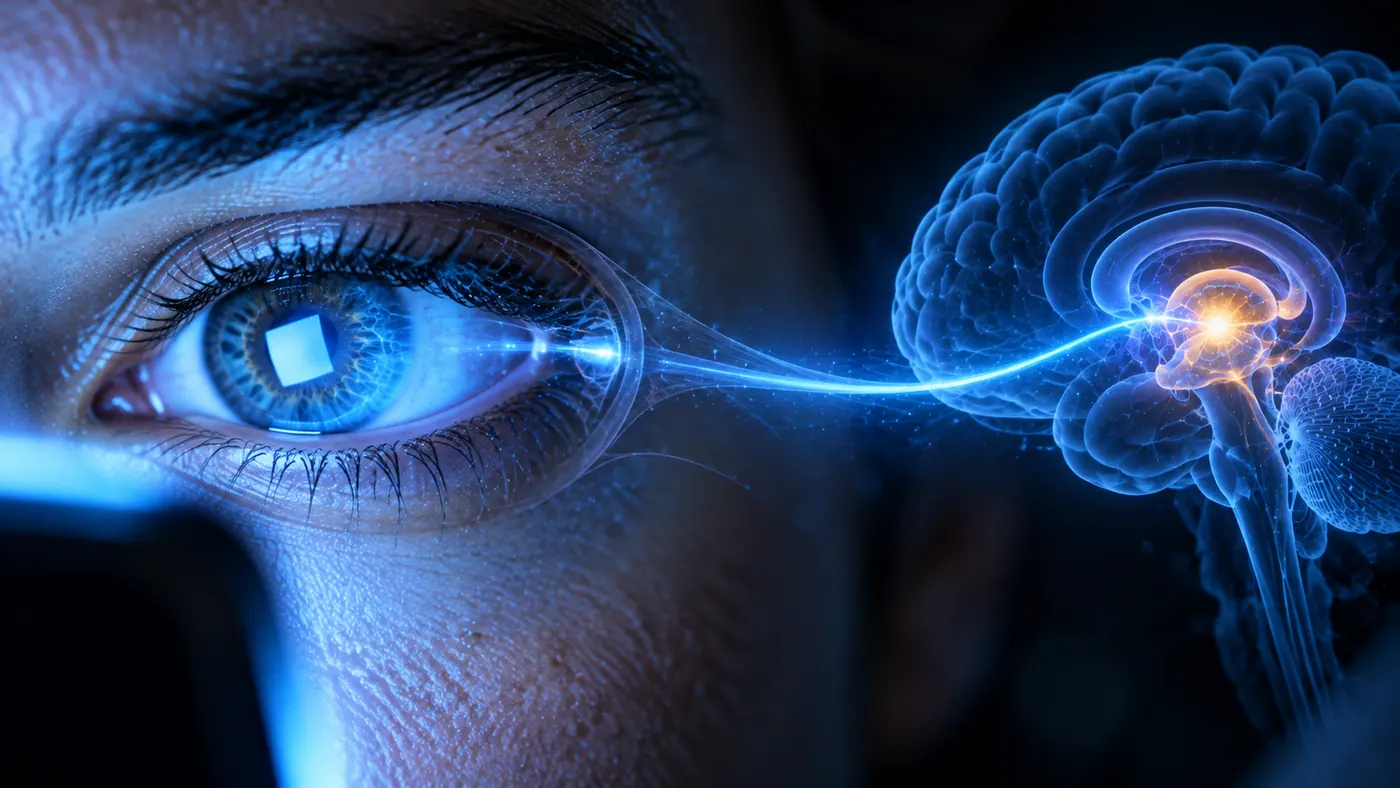
Your eyes do more than let you see. A specific class of light-sensitive cells in the retina, called intrinsically photosensitive retinal ganglion cells (ipRGCs), are not involved in forming images at all — their job is to detect ambient light levels and report them directly to the brain's master circadian clock, the suprachiasmatic nucleus. These cells are most sensitive to short-wavelength light, in the blue part of the visible spectrum, which is exactly the wavelength emitted heavily by daylight, LED lighting, and the screens on phones, tablets, and laptops.
When the suprachiasmatic nucleus receives a strong blue-light signal, it interprets that as "it is daytime" and signals the pineal gland to hold back melatonin release — the hormone responsible for initiating and maintaining sleep. This system works exactly as intended during the day. The problem is that it does not know the difference between the midday sun and a phone screen at 11pm — it responds to the wavelength and intensity of light reaching the retina, regardless of the clock on the wall.
What the Research Actually Shows
The Foundational eReader Study
The most widely cited study on this topic, published in the Proceedings of the National Academy of Sciences by Chang, Aeschbach, Duffy, and Czeisler, directly compared reading a light-emitting eReader to reading a printed book in the hours before bed, under tightly controlled laboratory conditions. Compared to the printed-book condition, evening eReader use suppressed melatonin, delayed the timing of the participants' circadian clock, suppressed REM sleep, and reduced alertness the following morning — even though total sleep time was similar in both conditions (see References below).
That last point matters: the damage was not to how long people slept, but to the quality and timing of their sleep and how alert they felt afterward. Getting eight hours after heavy evening screen use is not the same as getting eight hours after an evening spent in dim, warm light.
It's Not Just Screens — Room Lighting Matters Too
A 2025 study published in Scientific Reports went further, testing 52 household lamps across LED, incandescent, and CFL technologies, along with blue-light-filtering lenses and tunable LED bulbs. The findings were specific: cool white LED and CFL bulbs produced a median melatonin suppression of around 12.3%, compared to just 1.5% for incandescent bulbs. Tunable LED lamps showed real promise as a fix — suppression dropped from roughly 10% at a cool 5700K setting to just 0.1% at a warm 2100K setting. The study also found that most blue-light-filtering glasses tested were largely ineffective, though two specific brown-tinted lenses reduced estimated suppression to below 0.3% (see References below).
The takeaway is broader than "put your phone down." The overhead lights and lamps in your bedroom and living room in the hours before bed carry real weight too — and not all blue-light-blocking products marketed for sleep are equally effective.
What Actually Helps
Shift room lighting warmer after dusk. Based on the research above, switching to warm-toned bulbs (around 2000-2700K) or dimming overhead lights in the two to three hours before bed is one of the more directly evidence-supported changes available, given how sharply suppression dropped with warmer color temperatures in controlled testing.
Use built-in night-mode settings, but don't over-rely on them. Phone and laptop night-shift modes reduce blue-light emission, but they do not eliminate it entirely, and screen brightness and duration of use still matter.
Be skeptical of blue-light glasses as a stand-alone fix. The 2025 lens testing found most blue-light-filtering glasses on the market had little measurable effect on melatonin suppression — reducing overall evening light exposure matters more than the specific glasses worn.
Support the sleep system directly when full light control isn't realistic. Shift work, travel, family schedules, and late-night obligations mean many people cannot fully control their evening light exposure. This is where YuSleep's formulation of clinically studied natural ingredients is designed to support deeper, more restorative sleep and a more resilient circadian rhythm — working with the body's sleep-pressure system as a complement to good light habits, not a replacement for them.
Key Takeaways
✓ Light-sensitive cells in the retina (ipRGCs) report ambient light directly to your brain's circadian clock, most strongly in response to blue wavelengths
✓ A controlled PNAS study found evening eReader use suppressed melatonin, delayed circadian timing, reduced REM sleep, and lowered next-morning alertness compared to reading a printed book
✓ A 2025 study found cool white LED/CFL lighting suppressed melatonin by ~12.3% versus ~1.5% for incandescent bulbs — and that warm, dim lighting after dusk sharply reduces this effect
✓ Most blue-light-filtering glasses tested had little measurable benefit — reducing overall evening light exposure and color temperature matters more
✓ Since full control over evening light isn't always realistic, supporting the sleep and circadian system directly (e.g. with YuSleep) is a practical complement to better lighting habits
Frequently Asked Questions
How long before bed should I stop using screens?
The controlled research used an evening reading session of several hours before bed, so there's no single precise cutoff established — but reducing screen brightness and use in the last 1-2 hours before sleep, alongside warmer room lighting, reflects what the evidence supports.
Do blue-light glasses actually work?
Testing in a 2025 study found most blue-light-filtering glasses had minimal measurable effect on melatonin suppression, with only specific brown-tinted lenses showing strong effectiveness. Don't rely on glasses alone.
Does night mode on my phone solve the problem?
It helps reduce blue-light emission but does not eliminate the broader issue of screen brightness and evening light exposure duration — it is a partial measure, not a complete fix.
Is warm household lighting really that different from cool lighting?
Yes — laboratory testing found roughly an eightfold difference in melatonin suppression between cool white LED/CFL bulbs and warm incandescent bulbs, and tunable LEDs showed suppression could be reduced from ~10% to ~0.1% just by shifting color temperature.
Can YuSleep offset the effects of screen time before bed?
YuSleep is formulated to support deeper, more restorative sleep and healthy circadian rhythm function as a complement to good light habits — it is not a substitute for reducing evening light exposure where that's realistically possible.
Related Guides
→ Why You Wake Up at 3 AM: Causes and Solutions
→ Tired After 8 Hours Sleep? Here's Why and How to Fix It
→ How to Sleep Better for Brain Health: Complete Guide
→ Pineal Gland Calcification: What the Science Actually Says
→ YuSleep Review: Does This Sleep Formula Work?
Medical Disclaimer
This article is educational and does not replace professional medical advice. Persistent sleep difficulties, especially when accompanied by daytime impairment, mood changes, or symptoms of a diagnosable sleep disorder, should be evaluated by a qualified healthcare professional. Always consult your doctor before beginning any new supplement, particularly if you take prescription medications or have an existing medical condition.
Sharp Brain Lab is an independent editorial platform. We do not diagnose, treat, or cure any medical condition.
TL;DR
- The mechanism: light-sensitive retinal cells (ipRGCs) report blue-wavelength light directly to your brain's circadian clock, suppressing melatonin release
- The evidence: a controlled PNAS study found evening eReader use delayed circadian timing and reduced next-morning alertness; a 2025 study found ~12% melatonin suppression from cool LED lighting versus ~1.5% for warm incandescent
- The fix that doesn't fully work: most blue-light glasses tested showed minimal real-world benefit
- What helps: warmer, dimmer lighting after dusk, reduced evening screen time, and supporting the sleep system directly with something like YuSleep when full light control isn't realistic
This content is based on information from:
- Peer-reviewed circadian neuroscience research on retinal light detection and melatonin regulation
- A controlled laboratory study on evening light-emitting device use and sleep/circadian outcomes
- Peer-reviewed laboratory testing of household lighting and blue-light-filtering products
Last updated: 10 September 2026
References
1. Chang AM, Aeschbach D, Duffy JF, Czeisler CA. (2015). Evening use of light-emitting eReaders negatively affects sleep, circadian timing, and next-morning alertness. Proceedings of the National Academy of Sciences. 112(4):1232-1237.
2. Home lighting, blue-light filtering, and their effects on melatonin suppression. (2025). Scientific Reports.
recomendado
Brain Audio Programs
Audio Brain Programs
A 7-minute daily audio that uses neuroscience-backed sound frequencies to sharpen focus, boost memory, and unlock your brain's full potential. Used by 80,000+ people worldwide.
Brain Audio Programs
The Memory Wave
A targeted audio program that stimulates your brain's memory center using Theta wave technology. Specifically designed for adults over 40 who want sharper recall and clearer thinking.
Brain Supplements
Pineal Guardian X
A premium natural brain health supplement designed to support memory, mental clarity, focus, and long-term cognitive performance with a carefully selected blend of plant-based ingredients.