
White Noise for Tinnitus: Does Sound Masking Actually Work?
Fan noise, white noise apps, sound machines — do they really help tinnitus, or just distract from it? Here's what a 2025 clinical study found comparing sound therapy approaches.
disclosure This article contains affiliate links. Purchases may earn us a commission at no extra cost to you. We only recommend products we've reviewed.
featured in this review
NeuroTinn
Natural sound therapy program designed to help reduce tinnitus perception, promote relaxation, and improve sleep without medication.
White Noise for Tinnitus: Does Sound Masking Actually Work?
Fan noise. Static from an untuned radio. A phone app playing rain sounds on a loop. White noise is probably the single most common piece of tinnitus advice, passed around forums and given out by well-meaning friends for decades. It does help many people — but a 2025 clinical study puts some real numbers on a question that rarely gets asked: does plain white noise actually work as well as more targeted sound approaches, or does it just happen to be the easiest option to try?
Quick Answer
Does white noise help tinnitus? A 2025 feasibility study comparing plain white noise to two more personalized sound-enrichment approaches found that all three reduced tinnitus distress over four months — but white noise had a notably higher dropout rate (36%, versus lower rates for the personalized approaches), and the researchers suggested this gap reflects comfort and ease of long-term use rather than a real difference in how well each approach works when people actually stick with it. In plain terms: white noise isn't ineffective, but it may be harder to stay consistent with long-term than more tailored sound therapy — and consistency is exactly what tinnitus sound therapy requires to work.
What the 2025 Study Actually Compared
Researchers Fernández-Ledesma, Sanz-Fernández, Cuesta, and Cobo, publishing in Brain Sciences, ran a four-month feasibility study comparing three sound-based approaches: two versions of an "enriched acoustic environment" (one using randomized varied noise, one using structured gamma-tone sequences) against plain white noise. Of 125 participants enrolled, 92 completed the full study.
All three approaches produced statistically significant reductions in tinnitus distress — which is itself a useful finding, confirming that consistent sound-based therapy in general has real value regardless of the specific sound used. The more revealing result was in who stuck with each approach: white noise showed a 36% dropout rate, higher than the personalized enriched-environment groups, with the researchers noting evidence of selection bias among the people who did stay with white noise through to completion (see References below).
The study's own conclusion was direct: differences in outcome between these approaches "may be influenced by factors such as comfort and ease of use rather than efficacy alone." In other words, the sound itself wasn't clearly the deciding factor — how sustainable and tolerable it was to listen to, day after day, was.
Why "Just Turn On a Fan" Isn't the Whole Story
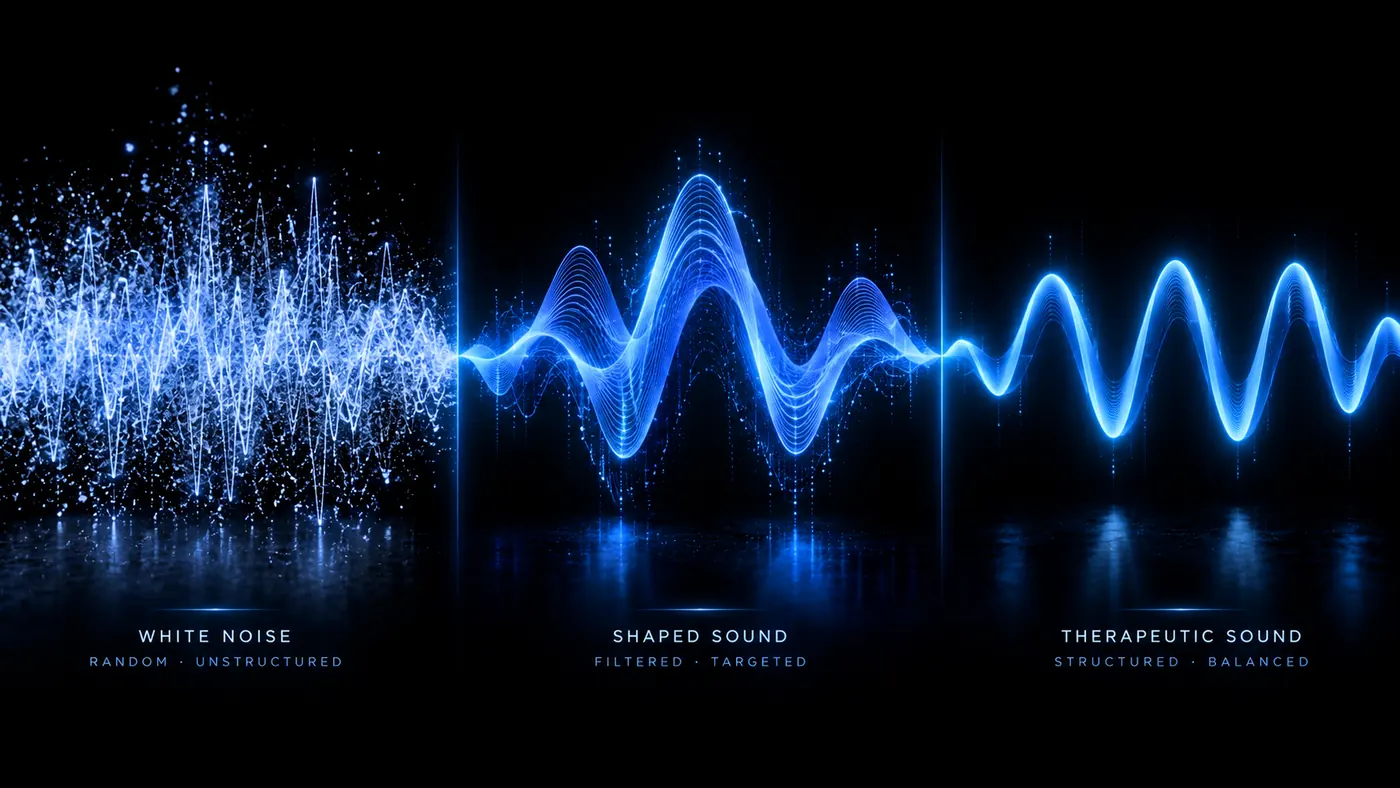
This distinction matters because of how tinnitus sound therapy is understood to work. It isn't primarily about drowning out the tinnitus signal in the moment — masking is a short-term side effect, not the mechanism responsible for lasting improvement. The more meaningful process is habituation: consistent, structured sound exposure over weeks and months helps the brain's auditory pathways gradually stop treating the tinnitus signal as something urgent and worth constant attention.
That process depends entirely on consistency. A sound approach that's mildly effective but genuinely enjoyable to use every day for months will likely outperform, in practice, a "theoretically stronger" approach that people quietly stop using after three weeks because it's flat, monotonous, or simply unpleasant to listen to at bedtime. This is exactly the pattern the 2025 study's dropout data points to.
Where a Structured Program Like NeuroTinn Fits
This is precisely the gap that plain white noise leaves open, and it's the design premise behind more structured sound programs. NeuroTinn uses precision binaural beats sound therapy rather than static, unstructured noise — built around the same underlying goal the 2025 study points to: sound that people can actually sustain using consistently, because it's designed to be engaging and tolerable rather than just functional background noise.
This doesn't mean plain white noise has no place — a fan or a sound machine is a reasonable, free, accessible starting point, and the 2025 data confirms it does genuinely help many people. But for those who've tried it and found themselves quietly not using it anymore after a few weeks, that's not necessarily a sign that sound therapy doesn't work for them — it may simply be a sign that this particular type of sound wasn't sustainable, and a more structured, personalized approach is worth trying instead.
Key Takeaways
✓ A 2025 study found white noise, along with two more personalized enriched-sound approaches, all significantly reduced tinnitus distress over four months
✓ White noise had a notably higher dropout rate (36%) than the personalized approaches, with researchers pointing to comfort and ease of use as the likely explanation
✓ Tinnitus sound therapy works primarily through habituation over time, not moment-to-moment masking — which makes long-term consistency the real determining factor
✓ A sound approach you'll actually keep using matters more than which specific sound is "theoretically" best
✓ Structured programs like NeuroTinn are designed around sustainable, engaging daily use — addressing the exact adherence gap the research identified with plain white noise
Frequently Asked Questions
Is white noise bad for tinnitus?
No — the 2025 study found it significantly reduced tinnitus distress, similar to more personalized approaches. It's a reasonable starting point, not something to avoid.
Why did people drop out of using white noise more than other sound therapies?
The study didn't pin down an exact cause, but the researchers suggested comfort and ease of long-term use were likely factors — plain, unstructured noise may simply be less pleasant to listen to consistently over months than more varied or personalized sound.
How long does sound therapy for tinnitus take to work?
The study followed participants for four months, with improvement building over that period. Sound-based tinnitus therapy in general is a gradual, consistency-dependent process rather than an instant fix.
Can I just use a free white noise app instead of a paid program?
You can, and it may genuinely help. The key question, based on this research, is whether you'll realistically keep using it consistently for months — if a free option keeps you engaged, that's a reasonable choice; if you find yourself abandoning it, a more structured program may serve you better long-term.
Does NeuroTinn use white noise?
No — NeuroTinn uses precision binaural beats sound therapy, a more structured approach distinct from unstructured white noise, designed around sustained daily engagement.
Related Guides
→ What Is Tinnitus? Complete Guide to Causes and Relief
→ How to Stop Ringing in Ears Naturally: 7 Methods
→ Tinnitus and Hearing Loss: Is There a Connection?
→ Tinnitus at Night: Why It Gets Worse and How to Sleep
→ NeuroTinn Review: Does It Actually Reduce Tinnitus?
→ Is There a Cure for Tinnitus? Realistic Expectations
Medical Disclaimer
This article is educational and does not replace professional medical advice. Persistent, sudden-onset, or one-sided tinnitus should be evaluated by a qualified healthcare professional. Sound therapy approaches, including white noise and structured programs like NeuroTinn, are complementary tools and not a substitute for medical evaluation of underlying causes.
Sharp Brain Lab is an independent editorial platform. We do not diagnose, treat, or cure any medical condition.
TL;DR
- The study: a 2025 Brain Sciences trial compared white noise to two personalized sound-enrichment approaches over 4 months
- The result: all three significantly reduced tinnitus distress, but white noise had a 36% dropout rate versus lower rates for personalized approaches
- The likely explanation: comfort and ease of long-term use, not raw efficacy — tinnitus sound therapy works through habituation, which requires consistency
- What this means: a sound approach you'll actually stick with matters more than theoretical strength — which is the gap structured programs like NeuroTinn are designed to close
This content is based on information from:
- A 2025 peer-reviewed feasibility study comparing sound therapy approaches for tinnitus
Last updated: 11 September 2026
References
1. Fernández-Ledesma D, Sanz-Fernández R, Cuesta M, Cobo P. (2025). Comparison of Enriched Acoustic Environment and White Noise as Sound Stimuli for Tinnitus Treatment: A 4-Month Feasibility Study. Brain Sciences. 15(4):342.
recomendado
Sleep Optimization
YuSleep
Recommended for adults who struggle with falling asleep, waking up at 3 AM, or waking up tired even after a full night's sleep. YuSleep combines clinically studied ingredients that support deeper, more restorative sleep without creating dependency.
Brain Supplements
Pineal Guardian X
A premium natural brain health supplement designed to support memory, mental clarity, focus, and long-term cognitive performance with a carefully selected blend of plant-based ingredients.
Brain Audio Programs
Audio Brain Programs
A 7-minute daily audio that uses neuroscience-backed sound frequencies to sharpen focus, boost memory, and unlock your brain's full potential. Used by 80,000+ people worldwide.
Brain Audio Programs
The Memory Wave
A targeted audio program that stimulates your brain's memory center using Theta wave technology. Specifically designed for adults over 40 who want sharper recall and clearer thinking.
Brain Audio Programs
The Genius Switch
Neuroscience-backed audio that activates your brain's peak performance mode in minutes. One of the highest-converting brain programs available — thousands of professionals use it daily.